
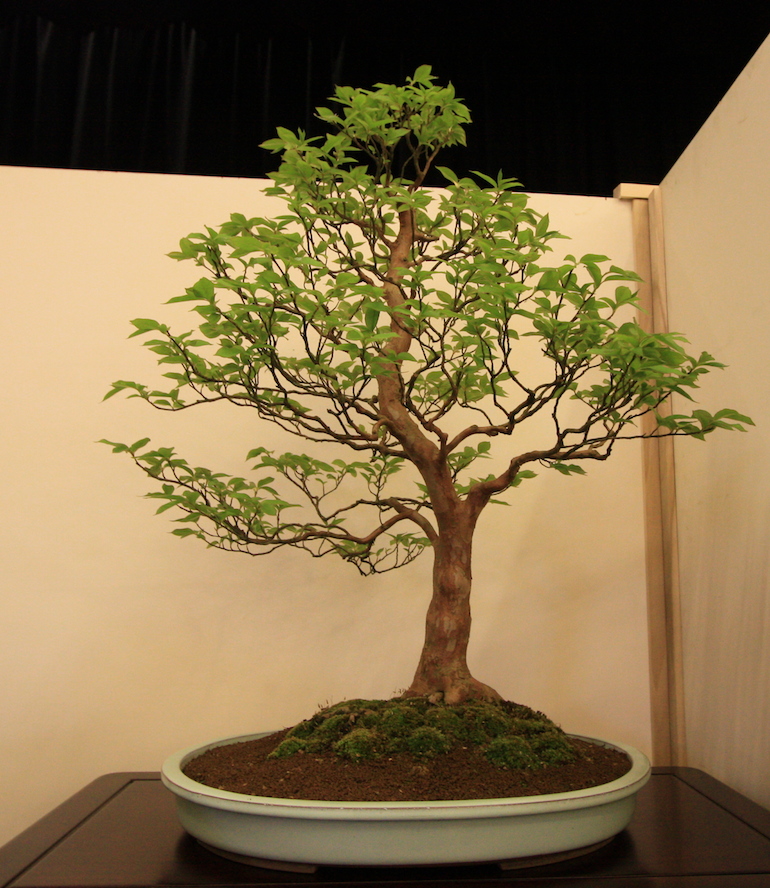
1st place – AW, Zelkova

2nd place – DM, Cotoneaster

3rd place – MP, Japanese Maple
Tree of the month was one of the closest we have had, not just in terms of tree as most were shohin sized, but also in points awarded.
1st place – AW, Zelkova
2nd place – DM, Cotoneaster
3rd place – MP, Japanese Maple
Tree of the month was one of the closest we have had, not just in terms of tree as most were shohin sized, but also in points awarded.

Its the Noelanders Trophy next weekend, the 18th & 19th January, arguably the biggest biggest deal in the european bonsai calendar, we recommend you get there if you can.

When assessing bonsai trees whether to judge, buy or just reviewing your own, to develop them or set up a display there are a range of criteria that can be considered. Some may be conflictual and there may be many rules, but some rules are always meant to be bent a little or broken.

Tree roots are in general the art of simplicity, they have three key functions, to anchor the tree, absorb water and nutrients and store excess food for the tree for later. In bonsai they are essential to maintaining a healthy bonsai tree and are often over looked as out of sight, out of mind, but it is important to dedicate time to refining the root system of your bonsai tree to ensure its longevity.
Stewartia trees are part of the Theaceae family alongside Camellia and have beautiful flowers; usually white with a mass of golden stamens that bloom in early summer and the flowers are bisexual. They are renowned for their decorative bark that flakes with age and leaves a mottled pattern on the trunk.

Japanese Black Pine (Pinus thunbergii)
Some of the two needle pines are commonly used as bonsai and include Scots Pine (Pinus sylvestris), Japanese Red Pine (Pinus densiflora), Mountain Pine (Pinus mugo) and Japanese Black Pine (Pinus thunbergii). They all have unique and distinct differences in their form and foliage making for quite dramatic and impressive bonsai trees in their own rights.

The Pine family (Pinaceae) is quite extensive with a range of species and genera including Abies, Cedrus, Keteleeria, Larix, Picea, Pinus, Pseudolarix, Pseudotsuga and Tsuga. Pines are softwood trees and are classified into groups dependent on the number of needles they have.

This is a stunning species of tree, the gorgeous white bark of the Japanese White Beech (Fagus crenate) is one of the fabulous facets of this tree. It belongs to the Fagaecea family of Beeches and the most common native Fagus sylvatica can be widely seen throughout the British Isles as a majestic tree in its own right as well as used in bonsai.

Hawthorns belong to the Roseacea family and are a hardy set of thorns, which are highly adaptable and thrive in a variety of locations. They are tolerant of wet and dry conditions and can be pruned hard to encourage new growth.

As many of you will know, Ritta and I love Japan, and we have become regular visitors. This enables us to indulge our love of the country and its culture, as well as our passion for bonsai and nishikigoi. In November 2013 we were fortunate to be able exhibit a bonsai that we own in the 33rd Taikan-ten bonsai exhibition in Kyoto. Taikan-ten is the most famous exhibition in western Japan, and in our view is only surpassed by Kokufu.